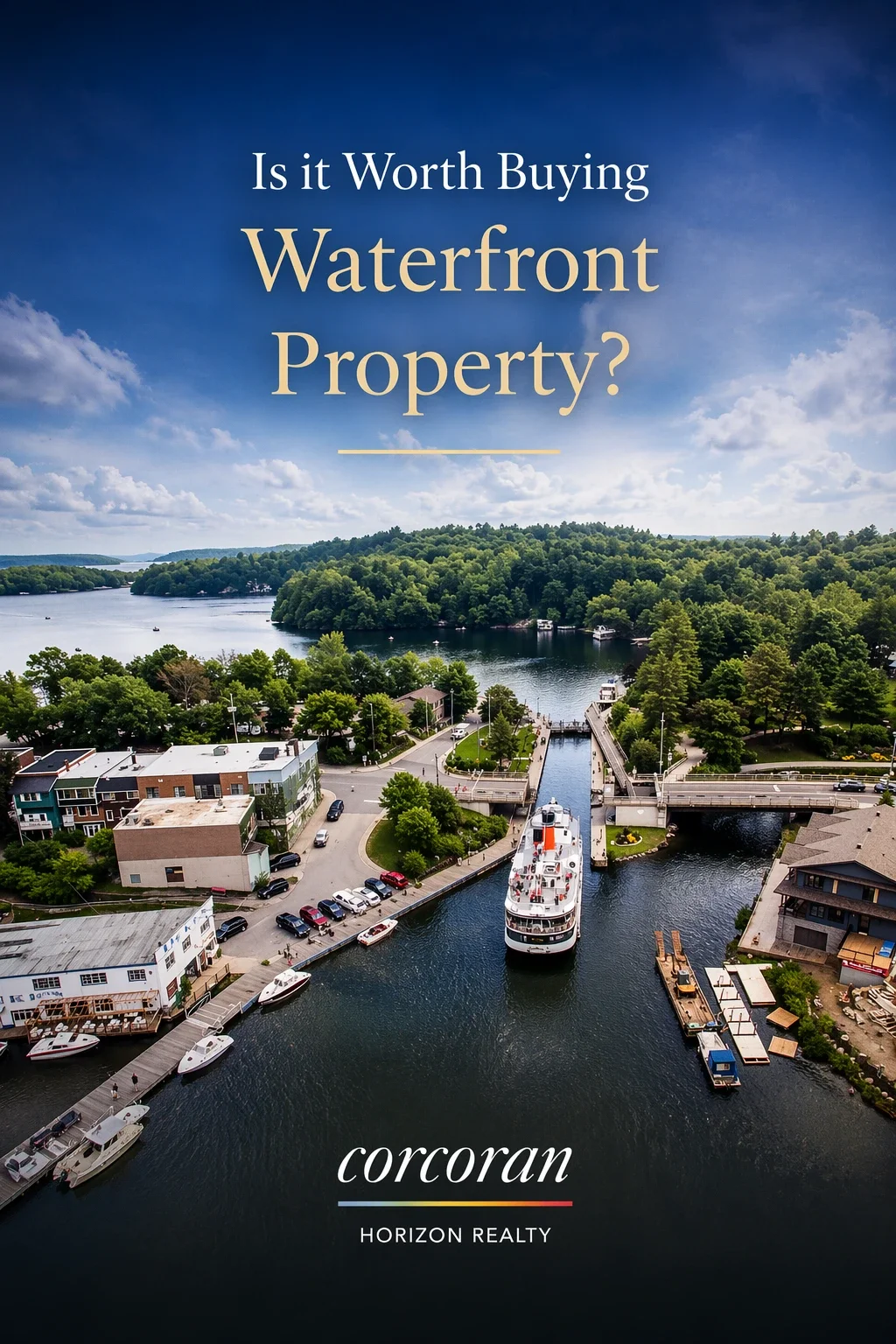
Is It Worth Buying Waterfront Property?
What to look for when buying a waterfront property?
Cottage Life Tips Series | Realtor Jeffrey Braun | Corcoran Horizon Realty
It is not just about a house. It is about waking up to still water, hearing loons instead of traffic, watching children run from the dock to the kitchen, and feeling that life slows down in the best possible way. In Muskoka and Simcoe County, that dream is especially powerful because the waterfront is not simply scenic. It is finite, emotional, and deeply tied to lifestyle. That scarcity is one reason well-located waterfront property has historically commanded a meaningful premium over comparable non-waterfront homes.
So, is it worth buying waterfront property?
In 2026, the answer is often yes, but only if you buy selectively, think long term, and understand what actually creates value. The market is no longer rewarding every lakefront property equally. Buyers have more choice, more leverage, and more reason to be disciplined. Local market commentary across Muskoka points to a more balanced environment with higher inventory and a clear “flight to quality,” where turn-key, four-season, well-positioned waterfront continues to outperform average product.
That is what makes this such an important question for today’s buyer.
The best waterfront properties can be extraordinary lifestyle assets and strong long-term holds. The wrong ones can be expensive lessons in maintenance, access, shoreline limitations, and resale disappointment.
The goal is not just to buy on the water.
The goal is to buy the right waterfront property.
The Short Answer: Yes, but Quality Matters More Than Ever
If your time horizon is at least seven to ten years, and you buy a strong asset at a rational price, waterfront property in Muskoka & Simcoe County can still make sense as both a lifestyle purchase and a long-term real estate investment. That conclusion is echoed across multiple 2026 regional market outlooks, which describe the current market as more balanced, more selective, and more favorable to patient buyers than the frenzy years of the early 2020s.But the key phrase is “strong asset.”
Not every waterfront property is equally desirable. In 2026, the market is separating premium, resilient properties from weaker ones more clearly than before. On the stronger end are waterfront homes with good shoreline, year-round access, winterization, appealing exposure, and layout or land quality that will still matter a decade from now. On the weaker end are cottages with poor frontage, deferred maintenance, difficult access, or compromises that make buyers hesitate.
That is why the conversation should not begin with “Should I buy waterfront?”
It should begin with “What kind of waterfront is actually worth owning?”
Why Waterfront Still Holds Its Appeal
Waterfront remains compelling because it combines three things buyers rarely get in one asset class: scarcity, lifestyle value, and emotional durability.There is only so much usable shoreline on desirable lakes. That is especially true in Muskoka’s top-tier lake systems, where demand from affluent lifestyle buyers and multi-generational families continues to support the best properties even in slower markets. Local 2026 commentary describes the Big Three, Lake Muskoka, Lake Rosseau, and Lake Joseph, as comparatively stable because they function as blue-chip, generational assets.
At the same time, the waterfront serves a practical modern need. Buyers still want nature, flexibility, work-from-cottage capability, and family space that feels restorative rather than crowded. That demand has not disappeared. It has simply become more discerning. Regional outlooks for 2026 describe returning buyer confidence, but with greater emphasis on condition, usability, and value. And then there is the emotional side.
Great waterfront tends to remain desirable because the experience is durable. Clean swimmable water, sunset exposure, privacy, and a shoreline that actually invites use do not go out of style.
What to Look For When Buying a Waterfront Property
This is the part that matters most.The difference between a rewarding waterfront purchase and a frustrating one is often hidden in the details.
Waterfront quality comes first
Buyers often spend too much time evaluating the cottage and not enough time evaluating the water. That is backwards. The house can be renovated. The shoreline usually cannot.The most desirable waterfront typically offers:
- Clean water
- Good swimming
- Usable frontage
- Decent depth off the dock
- An entry that works for your family and guests
- A shoreline that feels attractive in all seasons
If the waterfront itself is compromised, shallow and weedy, awkward, exposed, or hard to enjoy, the rest of the property has to work much harder to justify the price.
Exposure matters more than many buyers realize
Sun exposure shapes the entire ownership experience.It affects morning light, afternoon warmth, dock use, entertaining, swimming comfort, and sunset enjoyment. In cottage country, buyers often gravitate toward properties with south, southwest, or west-facing exposure because they support stronger light and a more emotionally appealing waterfront experience. Several 2026 local market commentaries specifically note that quality exposure is one of the features helping better properties move faster.
A shaded lake can still be beautiful. But if you want the type of waterfront most buyers compete for, exposure deserves close attention.
Four-season function is now a major premium feature
One of the biggest shifts in recent years is that buyers increasingly want waterfront property they can use beyond summer.That means:
- Year-round road access
- Reliable heating
- Proper insulation
- Winterized systems
- Stable utilities
- The internet that supports real life
If a property only works beautifully for eight weeks a year, buyers should price that limitation into the decision.
Access and usability are everything
Some buyers fall in love with an aerial photo and miss the everyday realities.Can you get there easily in winter?
Is the driveway practical?
Is the topography gentle enough for children, grandparents, and guests?
Can groceries get from the car to the kitchen without a workout?
Is the driveway practical?
Is the topography gentle enough for children, grandparents, and guests?
Can groceries get from the car to the kitchen without a workout?
Properties with easier, more usable access tend to age better as assets because they work better in real life. This is one reason year-round road access and level land are often worth a premium.
Condition beats potential in a selective market
In a “flight to quality” market, buyers have become less interested in inheriting major work unless the pricing clearly compensates for it.Turnkey or recently renovated waterfront properties are seeing stronger demand, while older, more functionally obsolete cottages are more exposed to longer selling times and capex risk. That pattern appears consistently across the 2026 Muskoka outlooks and buying guidance.
Potential still has value. But in 2026, confidence often has to offer more.
Is Waterfront Property a Good Investment?
Usually, yes, but only if you define “investment” correctly.Waterfront is rarely the best asset for a quick flip. It can be an excellent asset for long-term wealth preservation, lifestyle return, and patient appreciation. Local 2026 commentary describes a quality waterfront as a strategic long-term hold rather than a distressed bargain opportunity. Some market observers cite historical long-run appreciation for Muskoka waterfront in the mid-single to low-double digits, though exact returns vary widely by lake, property quality, purchase price, and holding period.
The strongest investment case usually exists when a property offers:
- Strong land value
- Desirable shoreline
- Four-season utility
- Broad resale appeal
- A plausible rental or hybrid-use story, subject to local rules
- A short holding period
- Compromised waterfront
- Heavy deferred maintenance
- Overpaying for a property whose flaws are permanent
Muskoka vs. Simcoe County: Where is the Waterfront More Worth It?
The answer depends on what you want the property to do.Muskoka: prestige, scarcity, and long-term hold appeal
Muskoka remains the stronger play for buyers prioritizing legacy value, prestige, and the classic luxury cottage experience. Local 2026 outlooks continue to describe top-tier Muskoka waterfront, especially on the Big Three, as relatively stable and more insulated than weaker outer-market inventory.Muskoka makes the most sense when your priorities include:
- Blue-chip long-term ownership
- Luxury lifestyle
- Premium shoreline and lake identity
- Strong emotional and resale appeal
Simcoe County and the Orillia-Severn corridor: utility and numbers
Simcoe County-area waterfront often offers better value per dollar, more year-round practicality, and easier access for buyers who want a property that functions as both a lifestyle asset and a usable second home. Regional commentary for 2026 points to strong demand in these more affordable waterfront corridors, especially where year-round living and hybrid use are realistic.Simcoe can make more sense when your priorities include:
- Easier drive time from the GTA
- Better year-round utility
- Lower capital outlay than the premium Muskoka
- Strong end-user practicality
The real costs buyers need to respect
This is where a dream purchase becomes either a wise one or a stressful one.Owning waterfront property comes with costs beyond mortgage payments. Local 2026 guidance and buyer resources point to higher overhead for waterfront owners, including taxes, insurance, dock repairs, well and septic servicing, winterization, and ongoing maintenance. Property-tax increases in Muskoka-area municipalities and Simcoe were also being discussed heading into 2026, adding to carrying-cost pressure.
Common waterfront ownership costs can include:
- Property taxes
- Waterfront insurance
- Dock repair or replacement
- Septic inspection and maintenance
- Well testing or water-system work
- Tree work and storm cleanup
- Winter access and winterization
- Shoreline, retaining, or erosion-related upkeep
What Decreases Property Value The Most on The Waterfront?
In 2026, the biggest value killers are usually not cosmetic. They are structural, practical, and permanent.The most common issues that decrease long-term value include:
- Poor shoreline quality
- Shallow or swampy frontage
- Problematic access
- Busy roads or noisy surroundings
- Lack of year-round usability
- Major deferred maintenance
- Weak resale story relative to the key and the location
A dated kitchen can be changed. A bad shoreline usually cannot.
What Type of Waterfront is Most Desirable?
The most desirable waterfront is usually the kind that feels easy, beautiful, and broadly enjoyable.That often means:
- Clean sw immable water
- Good sun exposure
- Usable frontage
- Gentle or sandy entry
- Decent depth off the dock
- Privacy
- A shoreline with a strong emotional feel
What is the 20/30/3 Rule, and Does it Apply Here?
The 20/30/3 rule is a general home-buying guideline. It usually refers to putting 20% down, keeping housing costs around 30% of gross income, and limiting the home price to roughly three times annual income.It can be a useful starting point for conventional housing discussions, but waterfront purchases often sit outside standard formulas because:
- Carrying costs are different
- Usage patterns vary
- Many buyers treat the property as both a lifestyle asset and a long-term hold.
- Luxury and discretionary spending are often part of the equation.
Is it Still Worth Buying Waterfront Property in 2026?
For many buyers, yes.In some ways, 2026 may be a better year to buy than the peak years because:- Inventory is higher
- FOMO is lower
- Buyers have more time for due diligence
- Negotiation is more realistic for non-unique properties
That does not mean waterfront is cheap. It means the market is more rational.And rational markets often create the best buying conditions for disciplined people.
A practical waterfront buying checklist
Before you make an offer, ask:- Is the waterfront itself excellent, or just acceptable?
- Does the exposure support the lifestyle I want?
- Can I use this property in more than one season?
- Is the access easy enough for real life?
- Are the carrying costs manageable?
- Would a future buyer still find this property special?
- Am I buying for personal use, investment, or a thoughtful mix of both?
Final Thoughts
So, is it worth buying waterfront property? Yes, when you buy the right one. The best waterfront properties offer more than scenery.They offer permanence, scarcity, emotional return, and a kind of lifestyle that remains desirable even as markets shift. But in 2026, buyers cannot rely on the word “waterfront” alone. They need to look deeper at shoreline, exposure, usability, carrying costs, and long-term value.That is especially true in Muskoka & Simcoe County, where the gap between average waterfront and exceptional waterfront is becoming easier to see, and more important to understand.
If you are considering a luxury Muskoka cottage, a Simcoe County waterfront home, or a long-term lakefront investment, connect with Realtor Jeffrey Braun through JeffreyBraun.ca and Corcoran Horizon Realty. In waterfront real estate, the right property can be extraordinary, but only when the strategy behind the purchase is just as strong.
10 Waterfront Sources Worth Reading: The Smart Buyer’s Lakefront Research List
These are the top source links behind the blog, chosen for their value on waterfront trends, Muskoka and Simcoe market insight, investment logic, and practical buying guidance.- 2026 Muskoka Luxury Waterfront Market Outlook: Entering the Flight-to-Quality Era
https://muskokacottagelistings.com/blog/2026-muskoka-luxury-waterfront-market-outlook-entering-the-flight-to-quality-era - 2026 Waterfront Market Predictions
https://thewaterfrontguru.ca/2026-waterfront-market-predictions - Muskoka Cottage Market 2025 Review + 2026 Forecast
https://findingyourmuskoka.ca/2026/01/23/muskoka-cottage-market-2025-review-2026-forecast/ - Is 2026 the Year to Buy Your Muskoka Cottage? Complete Guide
https://www.kristynkennedy.com/blog/is-2026-the-year-to-buy-your-muskoka-cottage-complete-guide/ - Buying a Muskoka Waterfront Cottage: 10 Things You Should Know Before You Buy
https://cocksrealty.ca/buying-a-muskoka-waterfront-cottage-10-things-you-should-know-before-you-buy/ - Waterfront vs Water-Access Cottage in Ontario
https://cvrealestate.com/blog-waterfront-vs-water-access-cottage-ontario/ - Muskoka Real Estate Q1 2026 Statistics for Homes & Cottages
https://findingyourmuskoka.ca/2026/04/03/muskoka-real-estate-q1-2026-statistics-for-homes-cottages/ - Muskoka Waterfront Market Report 2026
https://cottageinmuskoka.ca/muskoka-waterfront-market-report-2026/ - Waterfront Properties in Simcoe County and Ramara
https://weeksgroup.ca/searchpage/waterfront-properties-simcoe-county-and-ramara/ - Waterfront Cottages in Muskoka
https://buymuskoka.com/waterfront-cottages-in-muskoka/